Simulation game debriefing: A practical guide

The use of simulation games in business education and training typically follows a Brief-Play- Debrief cycle. In the brief phase, the facilitator explains the simulation to learners and recaps relevant contents. During play, learners should be in a state of flow, with minimum intervention from the facilitator. The debrief is the final and in many ways the most important step in the cycle, since this is where experiences are shared and interpreted, and where most of the learning happens. Unfortunately, the debrief phase is often unplanned and under-emphasized. In some cases, facilitators just ask if everything has gone well and then close the session. Too often, assumptions are made about what learners have taken away from the simulation experience, without discussing and reinforcing key learnings.
This article provides a short guide to help facilitators run effective and enjoyable simulation debriefings. The guide consists of four key success factors (‘tips’) for successful debriefing and a description of the three recommended steps in debriefing.
Tip 1: Allocate sufficient time for debrief. For example, if there is a single class or training session of 90 minutes, then around 30 minutes for the debrief phase is recommended. If the use of a simulation extends over multiple sessions, then there should be at least a short debrief at the end of each session. Never end simulation play without at least a short discussion with participants.
Tip 2: Use the debrief as an opportunity to link the simulation with the learning objectives. Simulations can be rich in content, with some content being more relevant to a particular group of learners and other content with less relevance. The debrief is an opportunity to focus the discussion on those aspects of the simulation with most relevance.
Tip 3: Involve participants. It is challenging for facilitators to stay in the background during the play phase and there can be a desire to revert to a traditional lecturing role during debrief. However, if participants are told (rather than asked) what they have learned from the simulation, they are likely to disengage. Learning happens through active participation in the learning process from beginning to end.
Tip 4: Celebrate winners while being sensitive to participants who did not perform well. Showing the leaderboard to all participants can generate positive excitement but can also make those with poor scores feel frustrated. Such feelings can then lead to unproductive discussions that take away from the learning experience. As a general guide, it is best to go into the specifics of winning simulation runs in front of the entire group (see Step 2 below) and to discuss poor runs only at the request from the concerned participant or discretely outside the main session.

A debrief can be structured easily as a three-step process:
Step 1: Let participants express themselves. At the end of the play phase, learners have different kinds of emotions, comments or questions that they may want to share. A useful first step in a debrief is to invite participants to share their thoughts in a free format. When someone has made a comment, it is usually best to move to the next comments so that as many people as possible get involved in the debrief. This is not the time to get into detailed discussions, but facilitators should take note of comments or questions that they want to respond to once participants have had their chance to speak.
Step 2: Review the leaderboard. Once the initial discussion is concluded it is time to share the leaderboard. In many simulations, the leaderboard contains key details of each run of the simulation that has been played. It is usually possible to sort these runs based on one of the columns (one of the winning criteria) so that the best performing run shows up on top. Showing this on a projector or a shared screen (in online sessions) captures everyone’s attention.
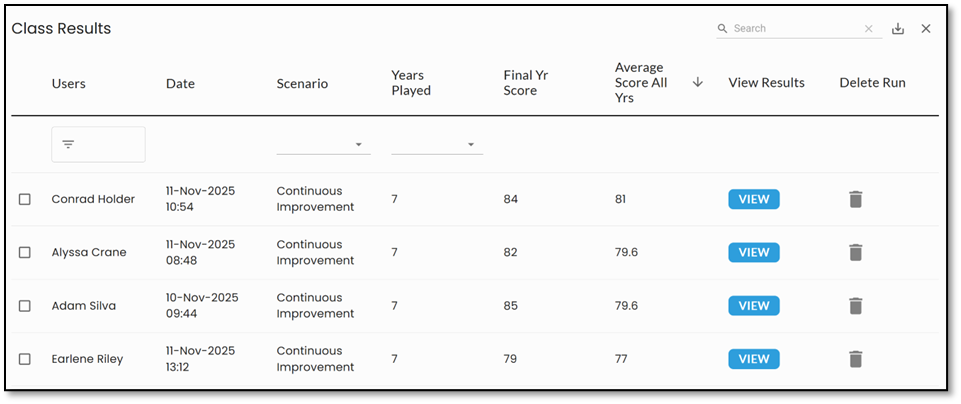
After an initial celebration of high scoring runs, the facilitator can invite learners to discuss their strategies. In Sim Institute’s simulations, the facilitator can enter any of the runs by clicking on the View button. As the facilitator navigates to key pages such as the Dashboard and the Game Summary or Decision History, learners are in a position to share the specifics of their decision-making with others.
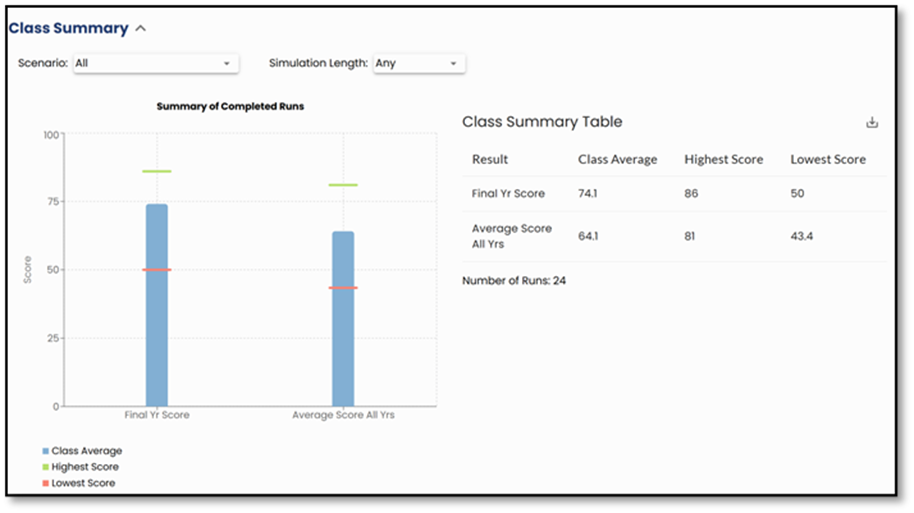
Showing overall statistics on the performance of the group can also help learners to put their score into perspective, although of course the importance of a score should not be over-emphasized at the expense of a discussion of the learning outcomes.
Step 3: Use debrief slides to consolidate learning and link the simulation back to the course. Most simulations come with a pack of debrief slides to support the debrief discussion. These slides are only a first step in deciding what slides to share with learners and should not be seen as another slide deck that needs to be discussed from beginning to end. Usually, facilitators will omit some slides from the debrief and may add other ones, all depending on the audience and learning objectives of the course.
Each debrief slide represents an opportunity to discuss a certain topic in the context of the overall course. Slides usually start by treating topics at a high level, before drilling down to specific topics. At the end, the key lessons and takeaways can be summarized.
During this final step of the debrief, there is an opportunity to link the simulation not only to the topics of the course but also to the real world. Practicing executives will be able to discuss how the simulation applies to their own context. In some cases, this can lead to participants criticizing the simulation for not being in line with their own experience. When such comments are made (“the simulation is wrong!”), the key for the facilitator is not to get defensive but to invite reflection on how the simulation differs from the context of participants. It is worth pointing out that a simulation represents only one example of a management challenge and the equations that are in the simulation model can’t take account of all possible scenarios or all the complexity that exists in the real world. Simulations exist not to replicate reality in a perfect way, but to help make learning more enjoyable and effective.
If learners are asked to give presentations to share their learning reflections, then the structure of the debrief can be adapted to accommodate for this. Presentations with room for follow up questions and discussions can be a useful component of a debrief and at the same time fulfil requirements of learning assessment. See our article on assessment of learning (here) for a guide.
Conclusion
Following these tips and steps can make the debrief effective and enjoyable for everyone involved. Course participants consolidate their learning and facilitators get insights into the effectiveness of the simulation exercise. Although the feedback received during the debrief is useful, it should not take the place of more structured ways of obtaining learner feedback since in any group it is not always the loudest person who is representative of all participants. Ways to assess the effectiveness of the use of simulation games are discussed in our October 2023 Newsletter (available here) and our free-to-use student survey template is available here.